
On this page
- Wet end usually needs a high molecular weight CPAM; effluent and DAF often use APAM.
- Running two well-matched grades typically outperforms one compromise grade.
- A one-hour jar test on your own furnish saves weeks of plant trial-and-error.
- Judge total polymer cost per ton of paper, not price per kilogram.
Why flocculant selection matters
A paper mill uses flocculant at several points — the wet end for retention and drainage, the DAF (dissolved air flotation) unit for white water recovery, and the effluent treatment plant for primary and secondary clarification. The wrong grade doesn't just perform poorly; it drives up polymer consumption, hurts machine runnability, loses fibre and fillers to the sewer, and increases downstream sludge volume.
In our experience supplying mills across India, most flocculant-related problems trace back to three sources: matching the wrong charge to the furnish, using a molecular weight that's too low for the settling task, or dosing at the wrong point in the process. All three are avoidable with a short structured selection process — that's what this guide walks through.
Step 1 — Map where you actually need flocculant
Before selecting any grade, list every point in the mill where a polyelectrolyte is (or should be) dosed. Each point has different requirements — one grade almost never covers all of them well.
| Dosing point | What it needs to do | Typical grade |
|---|---|---|
| Wet-end retention aid | Bridge fines and fillers onto fibre before drainage | Very high MW CPAM, low–medium charge |
| White water / DAF | Form tight flocs that float well with air | APAM (low–medium charge) |
| Primary clarifier (ETP) | Bridge organic + inorganic solids for settling | APAM or CPAM depending on stream |
| Sludge dewatering | Release water quickly under mechanical pressure | Ultra-high MW CPAM, medium–high charge |
Step 2 — Decide anionic or cationic at each point
The general rule for paper mills is: cationic (CPAM) on the wet end and on organic-rich effluent streams; anionic (APAM) on white water clarification, secondary polishing and streams high in inorganic fillers such as clay, calcium carbonate or talc.
The reason is charge. Paper mill fibres, fines and biological sludge carry a net negative surface charge, so a positively-charged CPAM attaches to them well. Filler-rich white water often carries positively-charged inorganic particles, which respond better to a negatively-charged APAM. A quick zeta potential check on the stream — if available — confirms this in minutes.
Step 3 — Pick molecular weight and charge density
Molecular weight decides how much bridging the polymer can do. Higher MW grades produce longer polymer chains, which can bridge more particles per molecule. Charge density decides how strongly the polymer neutralises the opposite charge on the particles.
| Application | Molecular weight | Charge density |
|---|---|---|
| Wet-end retention | Very high | Low – medium (cationic) |
| White water / DAF | High | Low – medium (anionic) |
| Effluent clarifier | High | Medium |
| Sludge dewatering | Ultra-high | Medium – high (cationic) |
In practice, holding two grades of CPAM (medium and high charge) and two grades of APAM (low and medium charge) covers almost every paper mill duty. Fine-tuning after that is a matter of dosing, not chemistry.
Step 4 — Confirm with a jar test
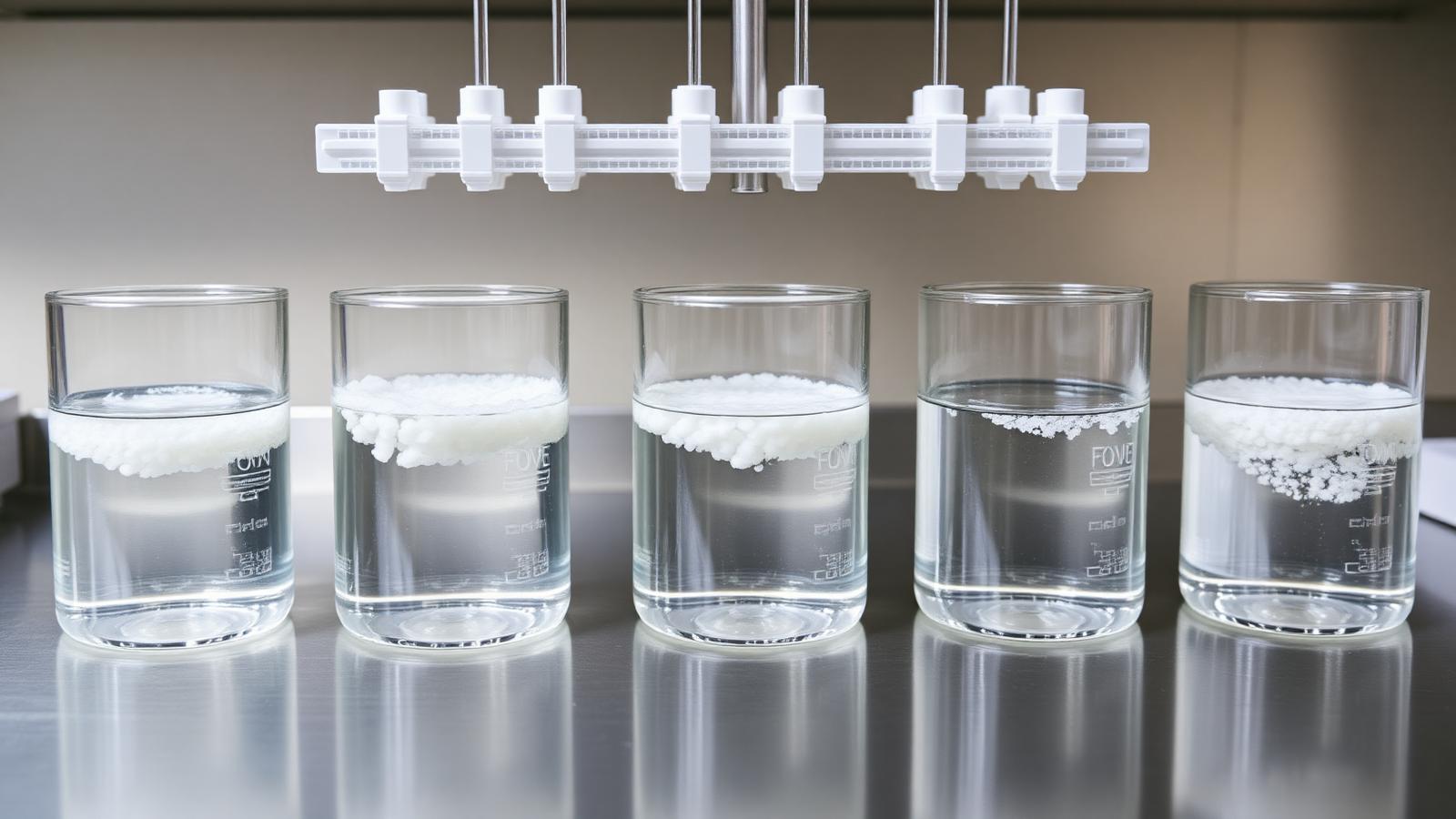
A jar test is the fastest, cheapest way to confirm the right grade before committing to bulk supply. It takes under an hour and typically saves weeks of trial-and-error at the plant scale.
- 1Sample fresh
Take a fresh sample of the actual stream — not a synthetic one — into six 500 ml beakers.
- 2Prepare working solution
Prepare 0.1% working solutions of each candidate polymer in clean (softened) water. Let it age 30–60 minutes to hydrate fully.
- 3Dose in increments
Dose the six beakers with increasing polymer — for example 1, 2, 4, 6, 8, 10 ppm on active basis.
- 4Mix briefly
Stir at high speed for 30 seconds to disperse, then slow to a gentle mix for one minute.
- 5Observe & compare
Stop stirring and observe: how fast the floc forms, how large it grows, how quickly it settles, and how clear the supernatant is after 5 minutes.
The grade and dose that gives the largest, fastest-settling floc with the clearest supernatant is your candidate for a plant trial. If two grades give similar clarity, pick the one with the lower dose — that's usually the cheaper long-term choice.
Step 5 — Get dosing right at the plant
Polymer performance depends as much on how it's dosed as on which grade is used. Make up the solution at 0.1–0.3% concentration in clean water — mill process water often contains ions that consume active polymer before it reaches the target stream. Age the solution for 30–60 minutes to allow full hydration.
Dose the diluted solution into a point of good turbulent mixing, but not into a high-shear pump or valve — mechanical shear will break the polymer chains and destroy performance. Give the polymer 15–60 seconds of contact time before the separation step (clarifier, DAF or press).
| Application | Typical reported dose range |
|---|---|
| Wet-end retention aid | 100–500 g / ton of paper |
| Effluent clarification | 2–10 ppm on treated flow |
| Sludge dewatering | 2–8 kg active polymer / ton dry solids |
Ranges reflect commonly reported industry values — actual dose for your mill should be confirmed by jar test and plant trial.
Common pitfalls we see in paper mills
- Using one grade everywhere to simplify purchasing
This almost always costs more in total polymer than running two well-matched grades. Even a 20% higher consumption on the retention aid alone pays for the second grade many times over.
- Preparing polymer in hard or chlorinated process water
Both consume active polymer before it reaches the target stream. Use softened or clean water for makeup.
- Storing bags in a damp warehouse
Polyacrylamide powder is hygroscopic — it clumps quickly when exposed to humidity. Keep bags sealed, off the floor, in a dry area.
- Judging polymer purely on price per kilogram
What matters is cost per ton of paper (for retention) or cost per m³ of effluent treated. A slightly more expensive grade that halves the dose is significantly cheaper overall.
Frequently asked questions
Which flocculant is best for a paper mill?+
Most paper mills use a combination: a high molecular weight cationic polyacrylamide (CPAM) as a retention aid on the wet end, and an anionic polyacrylamide (APAM) for white water clarification, DAF or sludge dewatering in the effluent plant. The right grade depends on furnish type, filler load, pH and equipment — a jar test with 2–3 candidate grades is the standard way to confirm.
What is the difference between anionic and cationic polyelectrolyte in paper mill use?+
Cationic (CPAM) carries a positive charge and works well on organic fibres, fines and biological sludge — typical for retention, DAF and effluent treatment. Anionic (APAM) carries a negative charge and is used where inorganic fillers or positively-charged suspended solids need to be settled — common in white water clarification and secondary clarifier polishing.
How much flocculant does a paper mill typically dose?+
Reported ranges in industry literature are typically 100–500 g per ton of paper for wet-end retention aids, and 2–10 ppm of active polymer for effluent treatment. Actual dose for any specific mill is confirmed by jar test and plant trial — real numbers vary with furnish, fillers, pH and equipment.
Can I use the same flocculant for retention and effluent?+
Usually not optimally. The wet end needs a very high molecular weight CPAM tuned for retention and drainage, while effluent treatment often calls for a different charge density — or an APAM for DAF sludge. Running two separate grades typically gives better performance than compromising on one.
How is flocculant supplied to paper mills in India?+
Standard packaging is 25 kg HDPE laminated bags. Continuous mills typically hold two to four weeks of stock and reorder on a scheduled basis. Shree Brahmani Trading dispatches anionic and cationic polyelectrolyte grades to paper mills across India from Mehsana, Gujarat, and offers sample supply for evaluation before bulk supply.
Supplying paper mills across India
Shree Brahmani Trading supplies anionic (APAM) and cationic (CPAM) polyelectrolyte in multiple molecular weight and charge density grades — including grades suited to paper mill retention, white water clarification, DAF units and effluent treatment. Standard packaging is 25 kg HDPE laminated bags; bulk quantities on inquiry. Sample supply available for jar testing on your own furnish. Dispatch pan-India from Mehsana, Gujarat.
Educational content. Numbers cited are typical industry ranges — always confirm against your own process by jar test and plant trial.