
Anionic Polyelectrolyte (Polyacrylamide) Powder
Industrial flocculant solution used in clarification, settling, separation and process support applications across paper mills, mineral processing, sand washing and chemical industries.
- Multiple grades on inquiry
- Sample evaluation support
- Wholesale supply across India
- Pan-India dispatch from Gujarat
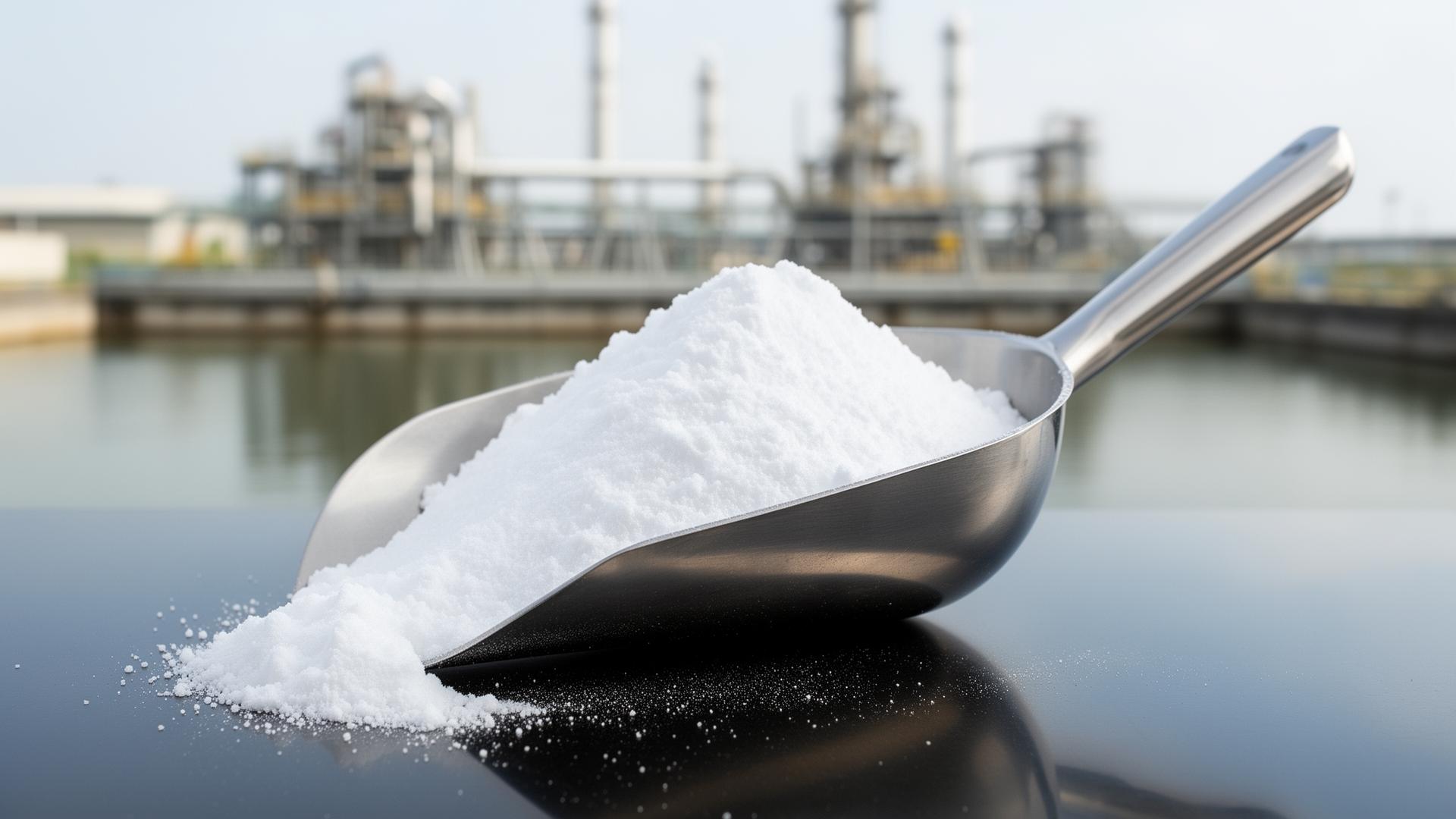
What is Anionic Polyelectrolyte?
Anionic Polyelectrolyte is a high molecular weight, water-soluble polymer based on polyacrylamide chemistry. It carries a net negative (anionic) charge along the polymer chain, which allows it to interact with positively charged or neutral suspended particles in water and process slurries. This interaction supports a process known as flocculation — where fine particles come together to form larger aggregates called flocs.
In industrial processes, removing suspended solids from water or slurry streams is a routine requirement. Particles in the micron and sub-micron range often settle very slowly under gravity alone. Adding a flocculant such as Anionic Polyelectrolyte changes how these particles behave: long polymer chains bridge multiple particles together, producing flocs that settle more rapidly and separate more cleanly in clarifiers, thickeners, settling tanks and dewatering equipment.
Polyacrylamide chemistry in brief
Polyacrylamide (PAM) is a polymer formed from acrylamide monomer units. When some of these units are modified to carry a negative charge (typically through partial hydrolysis or co-polymerisation), the resulting polymer is referred to as anionic polyacrylamide, or APAM. Different grades vary mainly in two parameters: molecular weight (how long the polymer chains are) and charge density (how strongly anionic the polymer is). These two parameters strongly influence how the polymer behaves in a given application.
Why it is used in industrial processes
Anionic Polyelectrolyte is one of the most widely used industrial flocculants because it is effective across a broad range of suspended-solid applications — particularly where particles carry a slight positive surface charge or where high molecular weight bridging is the dominant mechanism. Plants use it to improve clarifier performance, reduce settling time, support cleaner overflow water, improve dewatering of sludge and tailings, and reduce solids carryover in downstream operations.
Role in flocculation and particle aggregation
At a process level, dosing an anionic polymer into a slurry generally proceeds in three stages: dispersion of the polymer into the stream, adsorption of polymer chains onto particle surfaces, and bridging of multiple particles by individual polymer molecules. Proper mixing energy and contact time are important — too little and the polymer cannot disperse, too much and the flocs can be sheared apart. This is why dosing systems, mixing arrangements and feed-point selection are usually evaluated alongside polymer grade choice.
Product characteristics
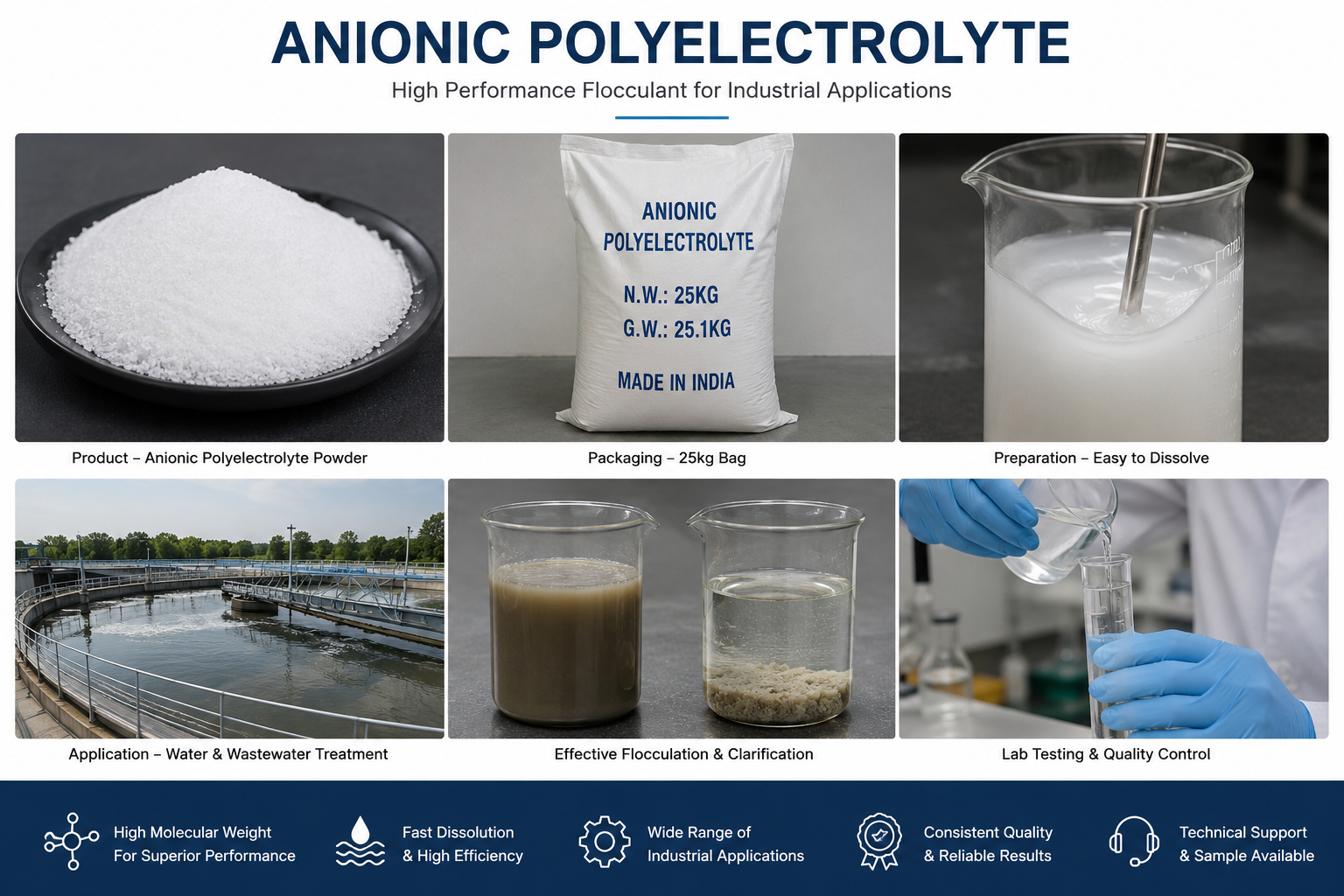
Anionic Polyelectrolyte (Polyacrylamide) Powder is supplied in industrial-grade specifications suitable for a wide range of process applications. Actual selection depends on the application — sample evaluation is recommended.
High Molecular Weight
Available in high molecular weight grades commonly used for industrial flocculation and clarification applications.
Flocculation Characteristics
Anionic charge supports particle aggregation in suitable slurry and process water systems.
Fast Dissolution
Designed to dissolve in water with proper mixing, supporting practical preparation in plant conditions.
Wide Grade Availability
Multiple grades — varying in molecular weight and charge density — discussed and confirmed on inquiry.
Industrial Applications
Used across paper mills, mineral processing, sand washing, chemical processing and clarification operations.
Easy Handling & Storage
Supplied in sealed industrial packaging suitable for normal warehouse storage when kept dry.
Where Anionic Polyelectrolyte is used
Anionic Polyelectrolyte (Polyacrylamide) is used across a wide range of industrial settling and clarification operations. Below are common application areas where it is typically considered.
Paper Mills
Used in paper manufacturing process water and clarification operations where solid–liquid separation is required.
Chemical Manufacturing
Applied in clarification and separation stages within chemical processing plants.
Mineral Processing
Supports settling and dewatering operations in mineral and ore processing.
Sand Washing
Used in sand washing plants to support settling of fine particles in process water.
Industrial Clarification
Used in general industrial clarification of process water and effluent streams.
Process Support
Acts as a process aid in various industrial separation and dewatering operations.
Why different grades exist
Industrial flocculation is not a one-size-fits-all process. Different operating conditions, raw materials and equipment combinations may respond very differently to the same polymer. Anionic Polyelectrolyte is therefore manufactured in multiple grades — varying primarily in molecular weight and anionic charge density — so that buyers can match polymer characteristics to their process.
We do not recommend selecting a grade based purely on a product name or generic description. Instead, we suggest discussing the application first and then trialling one or more candidate grades on a sample basis. This approach helps identify a polymer that is practically suitable for the specific plant rather than only theoretically suitable.
Factors that typically influence selection
Process conditions
Temperature, residence time, mixing energy, equipment type (clarifier, thickener, belt press, decanter, etc.)
Solids characteristics
Particle size distribution, surface charge, nature of solids (mineral, organic, fibre)
Water chemistry
pH, conductivity, hardness, presence of competing ions or organic matter
Dosage requirements
Acceptable dosing range, available preparation and feed equipment
Application requirements
Target settling rate, overflow clarity, sludge dryness or solids recovery goals
Discuss your application before committing to bulk supply
Because the performance of any flocculant depends on the actual process conditions at your plant, we encourage customers to discuss their application with us before placing bulk orders. Where useful, sample quantities can be made available for in-house trials so that suitability can be evaluated under real operating conditions.
This approach helps protect the buyer: instead of relying on generic performance claims, the decision is based on how a candidate grade actually behaves in your equipment, with your feed material and at your dosing system. We do not promise specific performance numbers without trial data — the goal is to help you identify a polymer that is genuinely fit for your purpose.
Talk to Ratilal J. Patel
Mehsana, Gujarat • Pan-India inquiry support
WhatsApp Inquiry +91 9879146692General product information
The information below is general and indicative. Actual product information for a specific grade is shared on inquiry. We do not publish unverified technical specifications.
| Appearance | White to off-white free-flowing powder / granular |
|---|---|
| Chemical Family | Polyacrylamide-based polymer |
| Ionic Type | Anionic |
| Solubility | Soluble in water with proper mixing |
| Physical Form | Powder / Granular |
| Molecular Weight | High molecular weight grades available on inquiry |
| Storage | Store in a cool, dry place; keep bags sealed; protect from moisture and direct sunlight |
| Shelf Life | As per manufacturer recommendations for sealed packaging |
| Packaging | 25 kg bags; bulk quantities on inquiry |
Available packaging
25 kg Bags
Standard industrial 25 kg bags suitable for handling, storage and dosing operations.
Bulk Packaging
Bulk packaging options can be discussed based on quantity, dispatch location and customer requirements.
Industrial Supply Quantities
Wholesale industrial supply quantities for plants and ongoing process requirements, confirmed on inquiry.
Working with us
Product Sourcing Support
Support in sourcing suitable industrial polymer grades from established manufacturing channels.
Multiple Grade Availability
Discussion across multiple anionic polymer grades to match different process requirements.
Technical Discussion Support
Practical discussion of your application before product selection — without unsupported performance claims.
Sample Evaluation Discussion
Where useful, sample evaluation can be discussed to support informed buying decisions.
Competitive Wholesale Supply
Competitive wholesale supply terms based on grade, packaging and quantity.
Pan-India Inquiry Support
Inquiry and dispatch support across India, handled from our Gujarat base.
Frequently Asked Questions
What is Anionic Polyelectrolyte?
+
Anionic Polyelectrolyte is a high molecular weight, water-soluble polymer based on polyacrylamide chemistry, carrying a negative (anionic) charge. It is commonly used as an industrial flocculant to support settling, clarification and dewatering of particles suspended in water or process slurries.
How is Anionic Polyelectrolyte used in industrial processes?
+
It is typically dissolved in water to prepare a working solution, which is then dosed into the process stream. The polymer helps fine suspended particles aggregate into larger flocs that settle or separate more readily. Exact preparation method and dosing depend on the application and equipment.
Which industries use Anionic Polyelectrolyte (Polyacrylamide) Powder?
+
It is widely used in paper mills, mineral processing, sand washing, ceramics, chemical manufacturing and other industries that require clarification, settling or dewatering of suspended solids.
Is sample evaluation support available?
+
Yes. Because performance depends on application conditions, we recommend sample evaluation before committing to bulk supply. Customers may share their application details with us to discuss suitable grades to trial.
How is Anionic Polyelectrolyte stored?
+
Sealed bags should be kept in a cool, dry, well-ventilated warehouse, protected from direct sunlight and moisture. Bags should be re-sealed if not fully used to maintain product condition.
How is grade selection determined?
+
Grade selection depends on factors such as slurry characteristics, particle size, charge, pH, dosage and equipment. We typically discuss the application with customers and recommend grades for trial; sample evaluation helps confirm a suitable choice.
What packaging options are available?
+
Standard packaging is 25 kg bags. Bulk packaging and larger industrial supply quantities can be discussed on inquiry based on requirement.
Is Anionic Polyelectrolyte the same as Polyacrylamide?
+
Polyacrylamide is the underlying polymer chemistry. Anionic Polyelectrolyte is a polyacrylamide-based polymer carrying an anionic (negative) charge. Cationic and non-ionic variants are also available depending on the application.
Can you supply across India?
+
Yes. Wholesale supply is dispatched from our Gujarat base to industrial customers across India based on inquiry and confirmed availability.
How can I get pricing?
+
Pricing depends on grade, packaging and quantity. Share your requirement on WhatsApp, phone or our inquiry form and our team will revert with available options.
Need Information or Want To Discuss Your Application?
Share a few details about your application and we will get back with grade options, packaging and inquiry support. For a faster response, use WhatsApp or call directly.
Contact: Ratilal J. Patel
Location: Mehsana, Gujarat, India
Email: shreebrahmanitrading91@gmail.com
Request Information
Tell us about your application — our team will revert with available options.