
DCP Slurry Settling Agent
Industrial settling solutions for DCP slurry clarification and process support applications — supplied in multiple grades, with sample-based evaluation support.
- Multiple grades on inquiry
- Sample evaluation support
- Wholesale supply across India
- Pan-India dispatch from Gujarat
What is DCP Slurry Settling Agent?
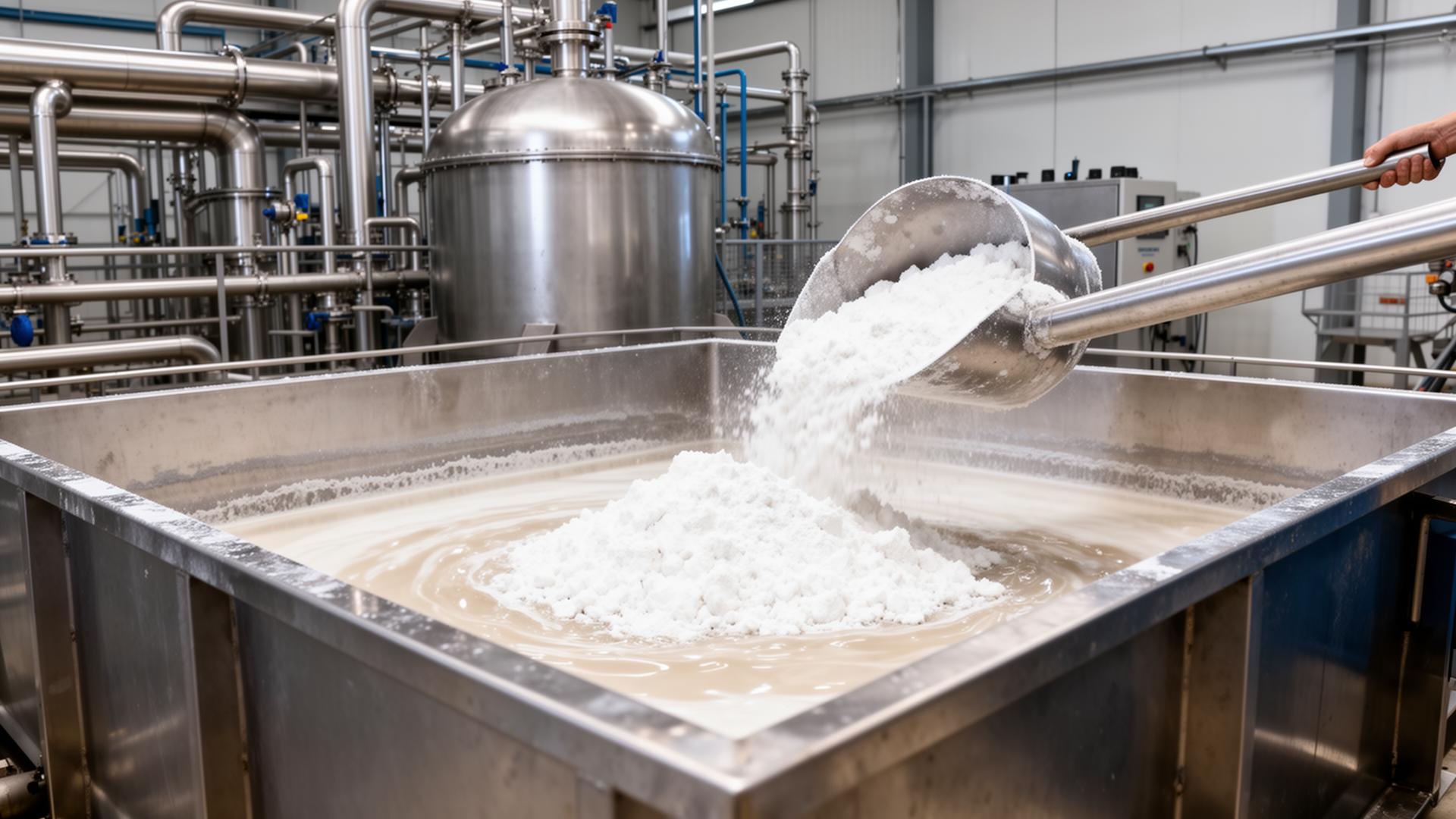
DCP Slurry Settling Agent is an industrial settling powder used as a process aid in DCP (Di-Calcium Phosphate) manufacturing and related phosphate processing operations. During DCP production, the process slurry typically contains a large quantity of very fine suspended particles that settle slowly under gravity alone. A suitable settling agent helps those particles aggregate into larger flocs that can separate more cleanly in settling tanks, thickeners and clarifiers.
Why settling matters in DCP processing
Settling and clarification are not isolated steps — they sit in the middle of the DCP process flow and influence almost everything that comes after. Poor settling generally means slower throughput, higher fines carry-over into the overflow, and additional load on filtration and washing operations downstream. When settling is supported properly, supernatant clarity improves, separation becomes more predictable, and the plant can operate closer to design capacity without overloading downstream equipment.
Why clarification affects process efficiency
Clarification quality directly influences process efficiency in a DCP plant. Clearer overflow water generally translates into reduced solids carry-over, better washing performance, more consistent downstream filtration and lower equipment wear over time. On the other hand, persistent turbidity in the supernatant typically forces operators to either reduce throughput or accept reduced product quality. A correctly selected settling agent supports a more stable, more predictable clarification stage.
Why different plants may require different grades
No two DCP plants are exactly alike. Raw material source, reactor design, water chemistry, solids loading, particle size distribution, residence time and downstream equipment all vary from one facility to the next. Because of this, a settling agent grade that works well at one plant may not be the most suitable choice at another. Multiple grades are made available specifically so that buyers can match polymer characteristics to the actual operating environment, rather than relying on a single generic product.
Why grade selection matters
Grade selection is the single most important decision when working with a DCP slurry settling agent. The right grade can support stable, predictable settling behaviour at a reasonable dosage. A poorly matched grade — even if technically a "settling agent" — can lead to over-dosing, inconsistent floc formation, persistent turbidity or unnecessary cost. This is true regardless of brand or manufacturer.
We do not recommend selecting a settling agent purely on the basis of a product name, marketing description or generic specification. The more reliable approach is to discuss the application first and then trial one or more candidate grades on a sample basis. This way the final selection is based on observed behaviour in the customer's own process — with the customer's feed material, equipment, water chemistry and operating conditions.
A grade that performs well at one facility may not perform the same way at another facility, even within the same industry. This is normal and expected. It is also the reason we make multiple grades available rather than promoting a single "best" product.
Factors that typically influence selection
Raw material characteristics
Source and composition of the phosphate raw material and any associated impurities or fines
Water chemistry
pH, conductivity, hardness, presence of competing ions and dissolved organic matter
Process conditions
Reactor design, residence time, temperature profile and mixing energy in the slurry stage
Solids concentration
Total suspended solids load, particle size distribution and surface charge characteristics
Operating parameters
Equipment type (thickener, clarifier, settling tank), dosing arrangement and acceptable dosage window
Operational objectives
Target supernatant clarity, settling rate, sludge volume and overall throughput targets
How product selection is evaluated
Different DCP processing facilities may operate under different conditions. Factors such as slurry characteristics, water chemistry, operating parameters and process requirements can influence product selection. For this reason, identifying a suitable grade often involves understanding the customer's specific application rather than recommending the same product for every facility.
Customer shares process information
The customer provides information about their DCP slurry process, settling challenges, operating conditions or performance objectives. This initial discussion establishes the process requirements and helps frame the product selection conversation.
Sample or parameter review
Where available, customers may provide slurry samples, laboratory information or process parameters to support evaluation. This information helps narrow the range of suitable grades and makes the product discussion more specific to the application.
Product evaluation discussion
Available grades and options are reviewed based on the application requirements and process conditions. The DCP Slurry Settling Agent discussion covers grade options, potential dosing approach and what the customer might observe during a trial.
Suitable grade identification
Potential grade options may be identified for customer evaluation based on the information available. This is presented as a recommendation for trial rather than a guaranteed outcome — the final grade selection is confirmed through the customer's own evaluation.
Customer trial & evaluation
Customers may conduct their own evaluation or plant trial to determine suitability under actual operating conditions. This step is essential because real-world process conditions — not laboratory data alone — determine whether a grade is appropriate for a specific facility.
Why testing matters
Because process conditions can vary between facilities, a grade that performs well in one application may not necessarily perform the same way in another. Product discussions, sample evaluation and customer testing can help identify suitable options for specific requirements. This structured approach to grade selection is what differentiates application-focused supply from generic product distribution.
Multiple grades, matched to the application
Multiple grades of DCP Slurry Settling Agent may be available depending on the customer's requirements. Depending on the application, the discussion may involve anionic polyelectrolyte-based grades, cationic polyelectrolyte-based grades, or other settling powder formulations positioned for fine particle clarification. The intent is to make available a range of options so that the most suitable chemistry can be identified for the plant.
We deliberately do not publish specific grade numbers, charge densities or molecular-weight figures on this page. Those values are commercially sensitive and, more importantly, they only become meaningful in the context of a defined application. Sharing a grade specification without first understanding the process can create more confusion than clarity, and may lead to incorrect product selection.
Suitable product selection is determined through discussion and evaluation. Once the application is understood, relevant grade options can be shared, and where useful, sample quantities can be discussed for trial. This approach helps ensure that any specification shared is actually relevant to the customer's requirement.
What we share on inquiry
- Relevant grade options for your application
- Indicative dosing approach for discussion
- Sample availability and trial planning
- Packaging and dispatch options
- Wholesale supply terms
A structured approach to grade selection
Because settling behaviour is sensitive to plant-specific conditions, we encourage a structured evaluation process before bulk supply. The aim is to identify a grade that genuinely fits the application, rather than relying on generic performance claims. Outcomes are not promised — the goal is to give the buyer enough information to make an informed decision.
- STEP 01
Application Discussion
Customer shares application details — slurry type, approximate solids loading, equipment, pH range and any known challenges.
- STEP 02
Product Discussion
Based on the application, candidate grades are discussed. Indicative dosing approaches and trial expectations are clarified.
- STEP 03
Sample Evaluation
Where useful, sample quantities can be made available. Trial behaviour is observed in the customer's actual process conditions.
- STEP 04
Grade Confirmation
Final grade options are confirmed based on observed behaviour. Packaging, supply terms and dispatch are then arranged.
Common challenges in DCP settling
Most DCP plants encounter one or more of the following challenges at some point. Recognising these challenges early helps frame the right product discussion. None of them are unusual, and most can be addressed through structured grade selection and trial evaluation.
Slow Settling Rates
Fine particles in DCP slurry can settle very slowly under gravity alone, increasing clarifier residence time and limiting overall throughput.
Poor Supernatant Clarity
Carry-over of fines into the overflow can affect downstream filtration, washing and product quality — making clarification a recurring concern.
Process Variability
Feed composition, pH and solids loading can fluctuate batch to batch, so a settling agent that worked well yesterday may behave differently today.
Grade Selection Difficulty
Choosing between settling agent grades without proper trial data can result in over-dosing, under-performance or unnecessary cost.
Changing Operating Conditions
Equipment changes, raw material changes or seasonal water quality shifts can require a different settling agent grade than what was previously used.
Need for Consistency
DCP plants generally need consistent settling behaviour — making structured product discussion and evaluation more reliable than ad-hoc selection.
Performance can vary between facilities, and even within the same facility under changing conditions. Treating settling as a process — not a one-time product choice — typically leads to more reliable outcomes over the long term.
Where DCP Slurry Settling Agent is used
DCP / MCP Manufacturing
Used as a process aid in Di-Calcium Phosphate and Mono-Calcium Phosphate production where slurry settling and clarification are part of the process.
Phosphate Processing
Applied in phosphate processing operations where fine particles need to be separated from process liquor for downstream handling.
Industrial Slurry Clarification
Used to support clarification of industrial slurry streams where suspended fines reduce settling rates and overflow clarity.
Mineral Processing
Considered as a settling aid in selected mineral processing operations involving fine particle slurries and thickener clarification.
Process Support Operations
Acts as a process aid in solid–liquid separation steps where settling rates need to be supported with a suitable polymer or settling agent.
Plant Optimisation Trials
Used during plant optimisation trials where multiple grades are evaluated against changing operating conditions and feed characteristics.
What support is available
Our role goes beyond simply quoting a product. We work with industrial buyers, plant operators, production managers and procurement teams to discuss the application, understand operating constraints and help narrow down candidate grades. The aim is to make grade selection a structured discussion rather than a guess.
Wherever useful, multiple grades can be evaluated in parallel so that the most suitable option is identified based on observed behaviour. Final commercial discussions — packaging, dispatch, ongoing supply — follow once the technical fit is reasonably confirmed.
Support available
Product discussions
Practical discussion on grade options based on the actual application and operating conditions
Sample support
Sample availability for trial evaluation, confirmed on inquiry based on requirement and location
Technical discussion
Technical discussions can be arranged where required to support grade selection and trial planning
Multiple grade trial
Multiple grades can be evaluated where useful, rather than committing to a single grade upfront
General product information
The information below is general and indicative. Specific grade-level information is shared on inquiry once the application is understood. We do not publish unverified technical specifications.
| Product Name | DCP Slurry Settling Agent |
|---|---|
| Product Category | Industrial Settling Powder / Flocculation Aid |
| Physical Form | Powder / Granular |
| Appearance | White to off-white free-flowing powder |
| Typical Use | Settling and clarification of DCP and related phosphate process slurries |
| Solubility | Designed for dissolution in water with proper mixing arrangements |
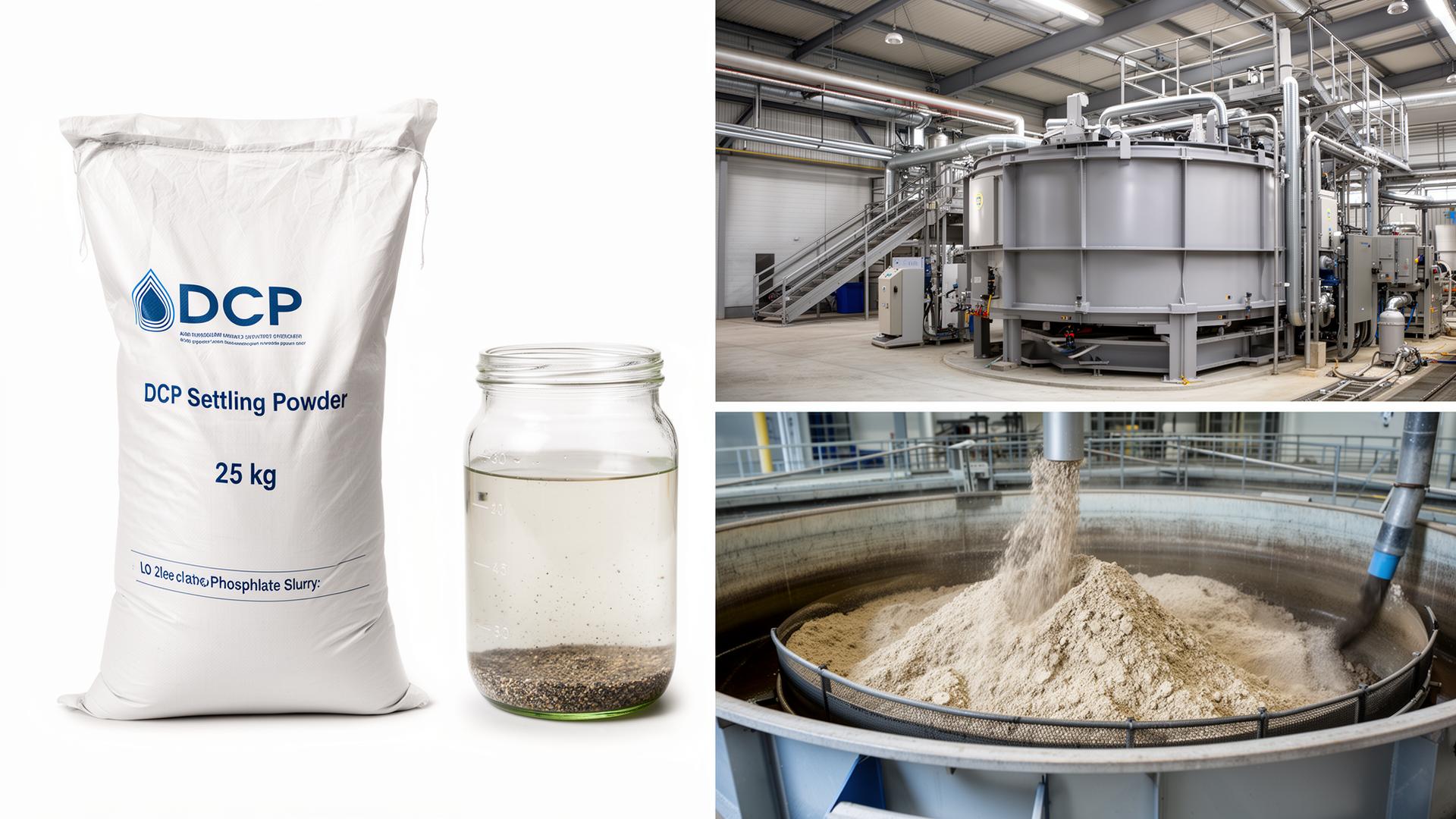
| Packaging Options | 25 kg industrial bags; bulk quantities on inquiry |
| Storage Recommendations | Store in a cool, dry place; keep bags sealed; protect from moisture and direct sunlight |
| Shelf Life | As per manufacturer recommendations for sealed packaging |
| Availability | Multiple grades on inquiry; wholesale supply across India |
Available packaging
25 kg Bags
Standard industrial 25 kg bags suitable for routine handling, storage and dosing operations at plant level.
Industrial Packaging
Sealed industrial packaging designed for normal warehouse storage when kept dry and protected from moisture and direct sunlight.
Bulk Supply Options
Bulk supply quantities for plants and ongoing process requirements can be discussed based on dispatch location and offtake.
Working with us
Multiple Grade Availability
Discussion across multiple settling agent grades to match different DCP plant conditions and operating requirements.
Product Discussion Support
Practical product discussion before selection — without unsupported performance claims or guaranteed-outcome marketing.
Sample Evaluation Support
Where useful, sample evaluation can be arranged so that grade fit is confirmed in the customer's actual process.
Wholesale Supply
Competitive wholesale supply terms based on grade, packaging and quantity confirmed on inquiry.
Industrial Application Focus
Focus on industrial applications and plant-level buyers, with discussions geared to operating conditions rather than generic specs.
Pan India Inquiry Support
Inquiry and dispatch support across India, handled from our Gujarat base via WhatsApp, phone and inquiry form.
Frequently Asked Questions
What is DCP Slurry Settling Agent?
+
DCP Slurry Settling Agent is an industrial settling powder used as a process aid in DCP (Di-Calcium Phosphate) and related phosphate processing operations. It helps fine particles in the process slurry aggregate so that solid–liquid separation in clarifiers and settling tanks can be supported more effectively. It is typically positioned within the broader family of industrial flocculants and settling powders.
Why do different DCP plants require different grades?
+
DCP plants vary in raw material source, water chemistry, reactor configuration, solids loading, particle size distribution and downstream equipment. All of these factors influence how a settling agent behaves. A grade that performs well at one facility may not be the best choice at another facility operating under different conditions — which is why multiple grades are made available and selection is treated as an application-specific decision.
How is the right grade determined?
+
Grade selection is best approached as a discussion. We typically begin by understanding the application — slurry type, approximate solids concentration, settling equipment, pH range and any known challenges. Based on that, one or more candidate grades are suggested for evaluation. Final selection is confirmed once trial behaviour is observed in the actual process.
Is sample support available?
+
Yes. Because settling performance is sensitive to plant-specific conditions, we encourage sample evaluation before bulk supply. Sample availability, dispatch and supporting discussion are confirmed on inquiry based on the application and customer location.
Can performance vary between facilities?
+
Yes, performance can and does vary between facilities. Settling behaviour depends on operating conditions, feed chemistry, equipment and dosing arrangement. For this reason we do not claim a single grade is suitable for every plant, and we do not make guaranteed performance commitments without trial data from the customer's own process.
How should DCP Slurry Settling Agent be stored?
+
Sealed bags should be kept in a cool, dry, well-ventilated warehouse, protected from direct sunlight, heat and moisture. Bags should be re-sealed if not fully used in one preparation, since settling agent powders are generally hygroscopic and can absorb ambient moisture over time, which may affect handling and dissolution.
What packaging options are available?
+
Standard packaging is 25 kg industrial bags. Bulk packaging and larger industrial supply quantities can be discussed on inquiry based on the requirement, dispatch location and ongoing offtake.
Do you publish exact grade specifications?
+
We share product information responsibly. General product information — physical form, appearance, category, packaging and storage — is published openly. Specific grade-level technical details are shared on inquiry once the application is understood, so that information shared is relevant to the customer's actual requirement.
Can you supply DCP Slurry Settling Agent across India?
+
Yes. Wholesale supply is arranged from our Gujarat base to industrial customers across India, based on inquiry, grade availability and confirmed dispatch details. Pan-India inquiry support is available through WhatsApp, phone or our inquiry form.
Is DCP Slurry Settling Agent the same as a polyelectrolyte?
+
DCP Slurry Settling Agent sits within the broader category of industrial settling agents. Depending on the application, options discussed may include anionic polyelectrolyte, cationic polyelectrolyte or other settling powder formulations. The suitable chemistry depends on the slurry characteristics and is part of the grade selection discussion.
How do I request pricing and availability?
+
Pricing depends on grade, packaging and quantity. Share your application details and expected requirement on WhatsApp, by phone or via our inquiry form, and our team will revert with available grade options and supply terms.
Related Products & Pages
Depending on the application, the suitable chemistry for a DCP settling agent discussion may involve Anionic Polyelectrolyte or Cationic Polyelectrolyte grades. Laboratory support can be arranged with our Laboratory Chemicals range.
Discuss Your DCP Application Requirements
Share a few details about your DCP application and our team will revert with available grade options, sample evaluation discussion and supply terms. For a faster response, use WhatsApp or call directly.
Contact: Ratilal J. Patel
Location: Mehsana, Gujarat, India
Email: shreebrahmanitrading91@gmail.com
Request Information
Tell us about your DCP application — our team will revert with available grade options.